
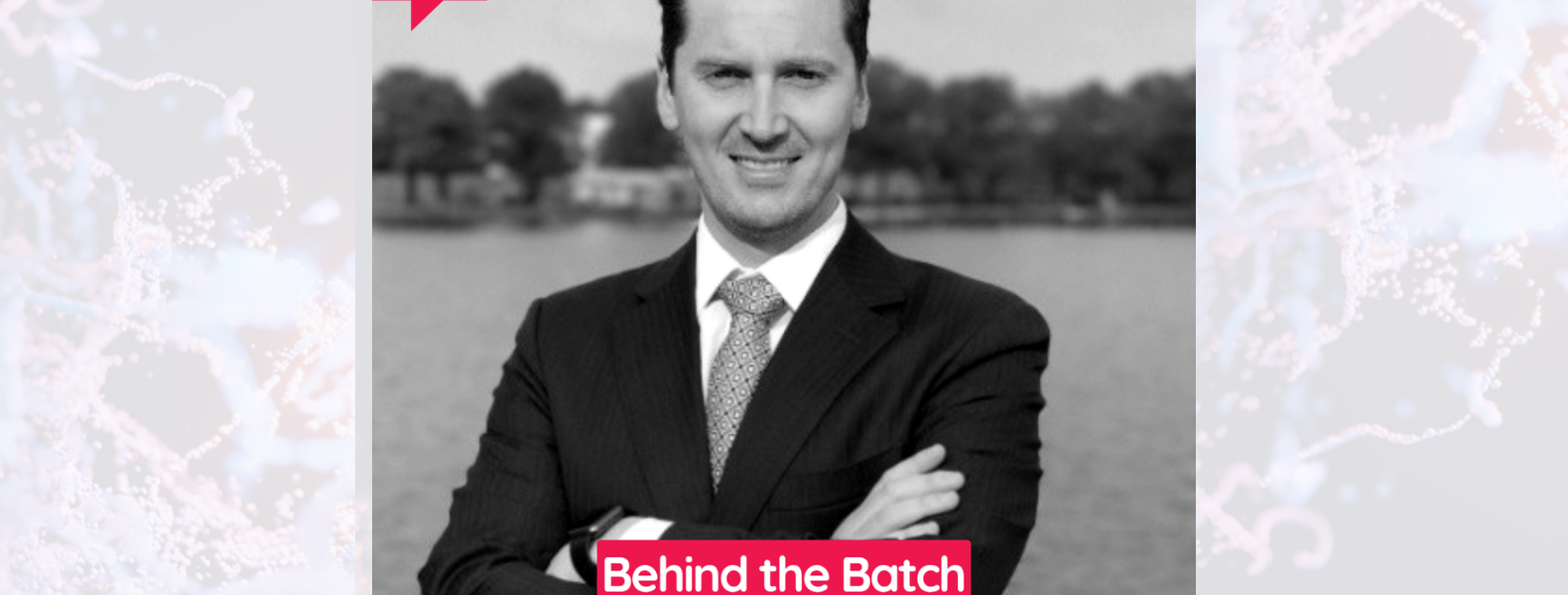
Behind the Batch Episode 1 – Andre Raposo
August 13, 2026
Behind the Batch spotlights the moments that shape the people pioneering cell and gene therapy. Failed batches, first viable runs, tech transfers, and everything in between. In episode 1, our host Alex Shephard chats with Andre Raposo, Senior Director of Innovation about his journey from fundamental HIV research to leading innovation in viral vector manufacturing at OXB. They explore the integration of automation, AI, and data-driven approaches in cell and gene therapy development, along with lessons learned from failures and successes.
Listen on Spotify > Listen on iTunes > Watch on YouTube >
Transcript
Alex: Hey everyone, welcome to Behind the Batch, the show where we spotlight the moments that shape people pioneering cell and gene therapy. The failed batches, first viable runs, tech transfers, and everything in between. I’m Alex Shephard, Head of Product at Tozaro, and I’ll be your host as we dive into the stories behind the breakthroughs. Our guest this week is Andre Raposo, Senior Director of Innovation at OXB, and one of the original pioneers in viral vector development and manufacturing, where he’s been building and leading innovation capabilities since 2017. His career has balanced post-doctoral research into HIV restriction factors at UCSF and George Washington University, upstream process development and lentiviral transduction science at GSK, and over 7 years at OXB progressing from Principal Scientist through Group Lead and Director to his current Senior Director role. That arc, from fundamental immunology and HIV latency research through to high-throughput automation, LCMS analytical development, and computer-aided biology at a commercial CDMO, gives Andre a perspective on what it actually takes to bring rigorous scientific thinking into a regulated manufacturing environment that very few people in this industry can match. Andre Raposo, welcome to the show.
Andre: Thank you very much, Alex. It’s a real pleasure to be here. Thank you.
Alex: So, to kick off at the beginning, every superhero has their origin story, as does every scientist. So, you did your PhD in immunology at Oxford and then spent years as a postdoc at UCSF and George Washington working on HIV restriction factors. That’s foundational science, obviously far from CDMO manufacturing. So, what was the moment or the reason that pulled you towards cell and gene therapy process development, and specifically towards a company like OXB?
Andre: Thank you, Alex. Thank you for that question. So, a little bit on the background, I think it’s important to sort of understand, you know, where I am now. So, the initial PhD and the postdocs were really focused on understanding the fundamental biology of HIV and its components and how HIV sort of infects cells and is able to sustain an infection. The transition into UCSF was a really good one because it was the first one where I started understanding more the patient context with HIV and how the epidemic started in San Francisco and how all of those individuals were sort of contributing to the science and to the discoveries. So there was quite a lot of fundamental biology and fundamental immunology. Then at GW, it was trying to understand more how does HIV latency persist in these individuals and how can we somehow create therapeutic interventions to sort of cure them. So obviously, you know, while I enjoy, you know, the scientific discovery, I wanted to have a bigger impact on patients’ lives and sort of contributing more to the health care system, I guess. So while the motivation was to you know, continue to do research, you know, I wanted to apply this research into patients. So gene therapy was really that bridge of cutting-edge research with clinical impact. So moving to GSK was, you know, a good step, I believe, because it was the first exposure to industrial biotechnology and then that transition from basic virology into upstream development, so at scale. And obviously, lentiviral vector transfection, transduction and modifying cells. So that matches you between academia, which is generate knowledge, publish, get grants, to industry, which is more create sustainable, scalable, reproducible solutions, was quite important for me at that stage. And then the next transition was OXB. So obviously, OXB, at the time, Oxford Biomedica, and you know, was a pioneer in lentiviral vector development. So you know, obviously, it had its roots in the University of Oxford and then it became a spin-out company. So OXB was not just developing the technology, but it was shaping the field. And I think that was really really important at that time. So my fit with virology I thought was good to contribute and I had the opportunity to join a team that was just starting with the new analytics, innovation, automation, and so forth. So I think I really combined the the good innovative thinking forward thinking with the science that I was that I was bringing. So to me it was was really the right move and I was very happy with that. In terms of OXB now what we’re doing is really combining automation, advanced analytics, computer aided biology, AI, biology driven, and all of this is to really to benefit ultimately the patients that we’re working with. So it continues to motivate me, you know, to bring these new technologies to patients and to sort of when you hear the stories from the patients that, you know, it was an OXB vector that helped them. It really, you know, brings them I guess that sort of momentum where you you’re like, “Yeah, well, I’m helping to do something.” So that’s sort of where I have been and where I am now.
Alex: Great, very interesting. So you mentioned when you first started at OXB in the earlier days was there still kind of some of that not necessarily academic but very kind of research innovative focused mindset that that was similar to the kind of mindset that that that was there during your post docs and your early research work in academia?
Andre: Yeah, obviously with you know, a flavor but much faster paced. So you know, it’s a little bit different the pace that you have in industry compared to academia. But I think fundamentally if the science is the same and if you bring those new ideas to the table, they will be heard, they will be you know, tested and they will be implemented as well. So I think OXB you know, does have that innovation momentum that really differentiates us from other CDMOs.
Alex: Right, time for a bit of therapy. So, every guest on Behind the Batch gets a chance to climb on their soapbox and have a little bit of a rant. There’s a lot of talk in this industry generally at the minute about automation as a cure-all for process variability and throughput challenges. So, based on what you’ve actually built at OXB, you’re standing up the computer-aided biology group, qualifying automated analytical methods for the GMPs. Is there a myth about automation in CGT manufacturing that you think needs to go?
Andre: Yeah, that’s a great question. So, I think, you know, myths are here to demystify them, right? So, let let’s start there. So, I think the biggest myth is that automation fixes bad processes. So, I think, you know, I can I can say that very clearly that automation amplifies existing processes. So, if you have a bad process, it will become a bad process at scale. And if you have a good process, it’ll become a good process at scale. So, I think that’s important to really establish. So, the automation really solves variability, throughput, cost, and compliance challenges, right? So, I think the important thing when implementing automation is do you understand the science first? If you understand the science first, then you can build the capacity, right? So, at OXB, we’ve been really building, you know, the automation, the advanced analytics, and, you know, computer-aided biology. But, most projects have really started on sane and very reliable biology. So, once you understand and identify those sources of variability and you simplify the workflows, then automation becomes much easier, right? So, in terms of automation, I think it’s also a change management challenge, right? You know, you need to change mindsets. The technology itself is rarely the, you know, the biggest hurdle, if you want it. So, I think there’s always challenges introducing automation when it comes to integrating the workflows, ensuring the data integrity, and you know, making sure that it’s qualifies in a regulatory environment, and it builds the trust of the users, right? So, the focus of automation has always to be in reliability, reproducibility, traceability, robustness, to make sure that it becomes a really good implementation in the environment that it’s designed to be. So, in in order to establish that, you really need to make sure that the scientists are going to benefit from it, right? So, another myth I believe in automation is that if you introduce automation, you’re going to have less jobs, right? But, I think that’s that that’s not the case at all. I think if more automation allows the scientists to do the work that they’re designed to do, which is to think, which is to interpret the data, which is to ask the right questions, and to recognize results that are not right, and to make those decisions. So, the way I view automation is automation is not the goal, automation is rather the enabler of allowing us to deliver better and more quality. So, uh to me, automation is is backed up by strong science, trusted data, and skilled workforce. That’s how I see the automation.
Alex: And building on that, that the next well, one of the next, big things in CHT and in science in general is really introduction of AI there on top of automation. So, would you say it’s kind of a similar case in terms of automation doesn’t necessarily replace jobs, it frees scientists up to give them the time to think and be a bit more big picture and strategic about what they should be doing. Do you think AI has the potential to do the same thing, or do you see that perhaps being a little bit of a different fit than our kind of standard automation at the minute?
Andre: I mean, absolutely. I think, you know, with AI, you know, we’re going to understand that it’s coming, you know, it’s going to happen. It’s already happening. I think in terms of AI in regulatory environments like in GMP and in in quality, we need to be very careful because obviously needs to be properly supervised and it needs to give the input that that we’re expecting it to be. Having said that, I think AI is going to help a lot with relatively boring tasks that can be properly automated and it can be properly given a way to expedite. For example, you know, compiling deviations and trends in deviations, compiling trends in CAPAs, all of these things that take quite a long time to execute from an operator perspective. I think AI can really help with that. In terms of asset development, you know, creating reports, creating you know, things that are relatively straightforward, I think it’s definitely going to have a very big impact. I think you know, in also in terms of what we’re using at OXB, which we’ll talk a little bit about as well in the design of experiment space and the statistical side of things, I think AI can have a big impact there as well and we can talk a little bit later about it as well.
Alex: Yeah, I think so. So, it’s actually in most of the conferences you go to, it’s definitely one of the topics that everyone’s discussing at the minute.
Andre: It’s there, absolutely it’s there.
Alex: going to have a big a big impact on the field in in in in many ways, I’m sure.
Andre: I agree.
Alex: Okay. So, failed batch time now. So, us scientists who have that sinking feeling when reviewing a new set of data. You spent years, as you just mentioned, running complex design of experiment strategies, high-throughput compound screening across upstream process dev. Tell us about the time a process and experiment or an analytical approach fell apart on your watch. What actually happened and what did it you learn from it?
Andre: Yeah, I love this question. I think it’s a nice one. So, in terms of design of experiments, so at OXB, we use DOE design of experiments to really understand how we can make viral vectors better in terms of quality, tighter, more robust processes. So, we tend to use this in many client work packages, but also internal development. So, our DOE designs is really to try and understand how multi-variables can contribute to the final product. So, if you’re making lentiviral vectors, for example, how does pH impact? How does the plasmid concentrations impact? How do the cell densities impact? So, all of these things they’re not one factor at a time variables. They’re multiple variables that work together. So, one example that I can share from an internal development was we were trying to understand if making more titer in a particular lentiviral vector would have the same impact on reporting cells or in primary cells, right? So, typically when you make lentiviral vectors, you then titrate them to assess their titer in reporting cells or in primary cells, which tends to be the ultimate goal. So, our assumptions was that if you make more vector, if it’s a higher titer vector, it will perform better on B cells, but also on the primary cells. So, we designed an experiment to assess that. We selected the variables. The rationale was sane and we had very strong confidence on what the output was going to be. On paper, it looked really robust. The model predicted higher gains in both cells. When we actually got the data, it basically showed that no, that’s not the case. So, more titer on one type of cells does not mean more titer on the other type of cells. So, we started scratching our heads. What’s going on? Did something go wrong? You know, did we do wrong analytics? Was there an operator error? Did the materials have an impact? So, we did quite a lot of sort of root cause analysis to try and understand what went wrong. The real problem was that the experiment went really well. It was just the outcome that basically was translating the biology. So, you know, this really identifies potential gaps in our understanding in what we are we’re trying to do. And uh you know, the biology is the utmost important thing. So, if we understand the biology, then we understand how to make these things better. So, what were the lessons learned? The lessons learned was that never make those assumptions. Do the experiment and then analyze the results and even if they’re bad results or not what we’re expecting, it’s really important to have them. So, you need to create that sort of environment where, you know, individuals can discuss bad results, where we can face those unexpected data and come up with a solution going forward. And so, I think that’s sort of what we really had done. And uh you know, I think this is a typical example of don’t make assumptions. Run the data, run the results, and then sort of try and interpret them based on the biology of what happened.
Alex: So, on that note, for any scientists who might be listening and they’re uh stuck with a process or an experiment that isn’t working, do you do you have any particular advice you’d give them?
Andre: For when experiments don’t work? Yeah, I mean, it’s a good point. I think, you know, the one of the advices is, you know, there’s always someone who can help. There’s always someone who can give advice or they have tried something similar. It’s really important to get together as a community within your company, within your team, and sort of discuss what you’re planning to do. Have a go at that, you know, discuss, I’m planning to do this, I’m hoping to see that. Do you think this is the right experimental approach? And people really come up with the most incredible ideas, either because they have a different perspective or because they’ve done it before or they read a paper that basically has done something similar. So, even if you have you know a bad experiment or if it’s not what it was supposed to tell you, have a go at trying to interpret why did that happen? Yeah? A lot of the times you know when we do experiments we focus a lot on technicality. Was there a particular problem with the technique? Was there a particular problem with the cells? Or is it just because it was a Friday? Right? So, I know sometimes you know there are things that you just cannot explain, right? So, the advice is you know always check with your peers you know what’s going on and I think if you have a good community of individuals around you you’ll get it through.
Alex: So, would you say that your perception of failed experiments and some of the challenges you’ve encountered has changed as you’ve moved into more senior leadership roles compared to when you were actually a scientist on the bench doing the pipetting yourself?
Andre: Yeah, it’s a good question. I think I’m giving a lot more value to failed experiments to be quite honest with you. I think failed experiments do inform you so much and you know it’s by basically doing things that that that fail that you’re going to get to that moment where you can say, “Wow, this is now you know we’ve cleared all variables, we’ve tried everything else, we know that this is the only way that it can work.” So, in my mind you know it has made me a better scientist, you know, a better leader and obviously when you are in the decision-making position it’s good to know that everything else has been tried so that you can have that decision done with clarity and you don’t have any regrets going forward.
Alex: So, on the more positive side of the coin, every scientist also remembers the key breakthroughs. So, when you were leading the computer-aided biology group at OXB, you’re building something that hadn’t existed previously at that company. You know, computer-aided design, data analysis capability to sit alongside the GMP operations. Can you walk us through the moment you knew when that approach was going to work and you were actually going to be able to have a real impact on how the company worked in the processes that that were going on?
Andre: Yeah, absolutely. I can tell you right away, Alex, it wasn’t an eureka moment. It wasn’t, you know, one of those “This is now working. This is amazing.” It was more of a gradual process. So, you know, it started off with curiosity and then building the credibility and then the adoption. I think that’s sort of the capacity grew over time. So, we obviously had the initial challenges. So, you know, obviously, as anything new, there is skepticism, which is understandable. So, the common questions that we were facing were, “Is this going to help us?” You know, “is this going to improve our process?” You know, “will it save time?” And obviously, in biotech and in industry, time is valuable, very very valuable. And novelty itself is not enough. So, I think the turning point was when the data started to come. So, we were starting to influence the decisions going forward with a project. And obviously, a project that that would have be payable by a particular client. So, the scientists started really approaching the team actively and the conversations were more like, “Can we answer this question by doing a DOE? Can we answer this question by applying some computer-aided design? And how can we do that?” Right? So, in process development, I think it’s it’s the prime example where time, resources, and the number of experiments are absolutely key. So, by using automation, DOE, and data-driven analysis, you can explore a bigger field, a bigger area of variables. Um and obviously, this gives you better insights and more rigor going into, for example, a PPQ, going into a validation. It’s a muc better process. So, I think the real reality is when the design of experiments and the modeling was matching the biology. So, it means that, you know, if you do more of this, then you perhaps instead of doing a 100 shake flask experiment, you can cut it down to 25 and still have the same impact on the on the output. So, it has really been a cultural change of a little bit of skepticism, then curiosity, and then building the credibility and the and the adoption. More recently, I can say as well, you know, with integrating proteomics into these processes has really allowed us to characterize and understand better, for example, downstream what are the proteins that are impacting, you know, an ion exchange, for example, and how can we then put something upstream that depletes some of these proteins that can be problematic. So, proteomics and bringing, I guess, this big data as well together with variables like titer, like pH, like plasmid ratios has really allowed us to take the next step, the next leap into making the processes better and more and more reliable. Um and I think, you know, finally, it is building the people as well. We have very talented people at R&D and the team has been building over the years. So, you know, we now have people who are very experienced in disciplines of biology, virology, data science, data processing, engineering, and obviously, all of this combines, it allows you to create an environment where success is happening. So, it’s something that we very much look forward to continuing and it has really allowed us as well to expedite going from early development into GMP production. So, this DOE process and the the design of experiments is paramount to what we are delivering at R&D.
Alex: Yeah, I think it’s, you know, as the case for a lot of commercial life science. Now, it’s really a whole team effort, isn’t it? As you say, and getting everyone all functions on board and having the evidence that that that people can buy into.
Andre: Absolutely. I couldn’t agree more. I was just I was just, you know, confirming that I think it’s really down to the people. The people are the more important the most important thing in everything that we do because if you create that team around you, then, you know, those decisions come naturally and everything is working very organically.
Alex: So, we’ve talked about failures and now some successes. So, I think to wrap up, let’s talk about what happens at the end. So, taking that process and then making it work in another department or on another site. So, I know you’ve been involved in bringing new technologies into OXB and then helping them to transition into the routine operations, into GMP manufacture. So, what does the handoff or the tech transfer look like when it goes well and is there any particular issue that could be a common cause for its breakdown?
Andre: Yeah, that’s a great question. So, in terms of bringing in new technologies, something that we have done over the past few years was to introduce Hamilton liquid handlers into our routine operations. Both for the more basic plate-based assays like PCR and ELISAs to more complex assays like cell culture. So, obviously, you know, working together with Hamilton, there have been quite a lot of back and forth with integrating all of these systems. So, that’s sort of the background, but the successful tech transfer is’nt really just about the technology itself, I think. It really depends on the people, the ownership, the timing, and a very well-aligned cross-functional effort, right? So, the goal is not really just, you know, improving and understanding how the technology is working. It’s creating something that is reliable, maintained, and improved over time. No new technology is going to be stuck in time. It’s going to evolve over the years. So, that the typical causes of failure that you see and you know, I can share some of that is when the teams have different priorities, right? So, if you for example, think about, you know, innovation, our priority is to make sure that there’s a technical success, that this works. But then, the operational priorities will be, you know, will this work in GMP? Will it be robust? Will it be compliant? And it will it add capacity? So, everything needs to really work together from the very beginning. So, the best transfers really start early. You need to get the involvement of the operations, quality, IT systems, validation, and everyone needs to understand why is this technology being brought forward? What is the problem that is trying to solve? And what’s the operating model, right? How are we going to have the handoffs and how is everything going to work? So, each stage needs to have an owner and a receiver, right? So, every time there needs to be that sort of handoff moment where, you know, everyone knows what’s happening and what’s the next the next step. Obviously, working in a regulatory environment adds additional complexity because it’s not just the handover. Is that, you know, will this add, you know, better reproducibility? Will we have less deviations? Will the operator you know, the different operators will it be consistent as well? You know, and its ready for an audit, for example? All of those things need to be put in place. So, I think, you know, it’s in terms of leadership, is re- tech transfers are more of a people exercise rather than a technological exercise. I think it’s aligning every person that is in that chain to make sure that they have the responsibility and they own it. So, I think that’sreally what tech transfer is about is creating alignment, ownership, and you know, readiness for these things to be implemented. Does that make sense, yeah?
Alex: Yeah, yeah, absolutely. I think the other element that can sometimes be a challenge for people is that a lot of that tech transfer process comes down to capturing tacit knowledge that may not always be defined in a SOP or something. Do you have any way to make sure that that kind of in-depth knowledge is successfully transferred along with the process? Is there any recommendations to help people do that?
Andre: Yeah, like I said, it’s involving the people that are going to be on the receiving end as early as possible. Obviously, you know, when these technologies are initially developed, there will be superusers. There will be people who are specialized in delivering that technology. But if you involve the receiving department from the very beginning, then they understand what the challenge is and where the sort of pain points are, rather than just following a protocol, and then something happens that is not on the protocol, and you know, they won’t know exactly what to do. So, I think it’s really involving the team as early as possible and delivering that almost like a crash course of, you know, what can happen, you know, what are the pain points, and you know, what is the most likelihood of something going south in in in a particular workflow. So, at OXB, one of the things that we have done was to train the individuals from the very beginning, rather than having to rely on, you know, the supplier to come in and fix the problem. So, we’ve learned the code, we understand how things work, we can troubleshoot. The only thing we can’t really do is really change hardware because obviously we’re not engineers of that particular company. But everything that is software related, anything that is error handling related, we can intervene and we can fix on the spot. The other thing that, you know, that we do to mitigate pain points, particularly in GMP operations, is to have, you know, individuals available every single moment of the experiment to troubleshoot. So, we know when things are going into production, we know when a particular asset is being done. So, we have ways to communicate with each other obviously in compliant ways to allow us to troubleshoot in real time, which is which is very very advantageous.
Alex: Yeah. Now, I did I think that that’s really really insightful and hopefully really helpful for our listeners. So, thank you very much Andre for taking the time to talk to us about building innovation capacity inside the CDMO, what it actually takes to make automation useful in a GMP environment, and the long road from academic HIV research to viral vector manufacturing leadership. So, Andre, it’s been a pleasure. Thank you very much for your time, and everyone else, we will see you next time on Behind the Batch.
Andre: Thank you very much, Alex. Bye-bye, everyone.