
A new class of affinity ligands revolutionizing bioprocessing
Tozaro’s Smart Polymer™ Platform Technology is redefining how affinity binders are developed for bioprocessing applications. Unlike traditional antibodies, peptides and biologically derived ligands, Smart Polymers™ are computationally designed around the target molecule and chemically synthesized for scalable, cost effective manufacture.
The Smart Polymer™ platform delivers tailored affinity solutions faster, more cost-effectively and with greater flexibility than conventional approaches.
The challenge with traditional affinity technologies
Bioprocessing relies heavily on affinity reagents for purification, analytics and process development. However, conventional binders such as antibodies and peptides often present significant challenges:
- Lengthy discovery and screening processes
- High development and manufacturing costs
- Limited control over binding and elution characteristics
- Difficult adaptation to emerging therapeutic modalities
- Instability under alkaline cleaning conditions
As advanced therapies, biologics and nucleic acid medicines continue to grow, the industry requires a new generation of affinity technologies.
The Smart Polymer™ Platform
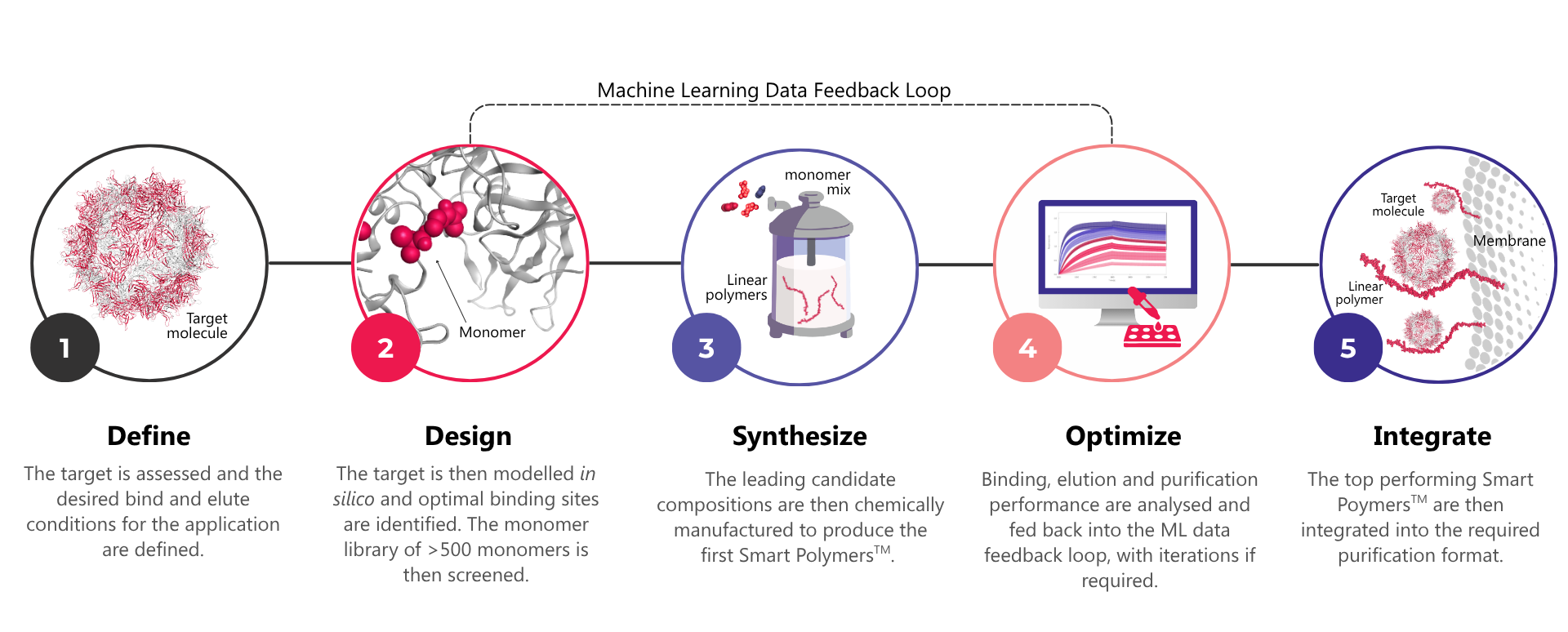
Combining computational design and chemical synthesis to create a new generation of affinity binders
The Smart Polymer™ Platform combines computational modelling, machine learning, materials science and rapid in vitro validation to create bespoke affinity ligands.
The process begins with detailed in silico mapping of the target molecule, to identify optimal binding regions. Billions of potential polymer architectures are then evaluated against these regions using proprietary computational workflows and an extensive monomer library of >500 monomers. This represents a much larger chemical space than that available to antibodies and peptides using ca. 20 amino acids.
The highest-performing candidates are synthesized and validated in vitro, enabling rapid selection of ligands tailored to the specific workflow requirements of the application.
Unlike conventional affinity ligands, Smart Polymers™ can be engineered across a range of binding strengths, from ultra-high affinity interactions for analytical applications, to controlled affinity profiles for efficient capture and gentle elution during downstream processing.

possible binder designs
per target

successful hit rate from synthesis to selection

to initial candidate
selection

Proven in Viral Vector Purification
The first commercial applications of Smart Polymers™ focus on one of the greatest challenges in advanced therapy manufacturing: efficient, scalable viral vector purification.
Tozaro has successfully developed Smart Polymer™ ligands targeting both adeno-associated virus (AAV) and lentiviral vectors (LVV), demonstrating the ability to achieve high recovery, excellent purity, and process-compatible elution profiles.
By combining performance with cost-effective synthetic manufacturability, Smart Polymers™ offer a compelling alternative to traditional affinity approaches for CDMOs, biotechs and pharmaceutical manufacturers developing
next-generation therapies.
Bioprocessing beyond Viral Vectors
Smart Polymer™ technology is not limited to viral vectors. Because the platform is built around target-specific computational design, Smart Polymers™ can be developed against a broad range of biologically relevant molecules and structures.
Potential applications include:
- Complex antibody purification
- Recombinant protein purification
- DNA and RNA capture
- Viral vaccine manufacturing
- Cell isolation and enrichment
As biologics become increasingly complex, Smart Polymers provide a scalable platform capable of addressing emerging purification and analytical challenges across the life sciences sector.
Why Smart Polymers™ are different
| Traditional Affinity Ligands | Smart Polymer™ Technology |
|---|---|
| Biologically derived | Fully synthetic |
| Screening based discovery | Computationally designed |
| Long development timelines | Rapid development cycles |
| Limited tunability | Tuned for the required workflow |
| Complex manufacturing | Scalable cell-free chemical synthesis |
| Poor robustness | Strong resistance to harsh conditions |
| Higher supply chain risk | Repeatable synthetic production |
to discuss your affinity ligand requirements
Resources
FAQs
Traditional affinity ligands are typically discovered through biological screening processes and produced using biological manufacturing systems. Smart Polymers™ are designed in silico utilizing machine learning and manufactured synthetically, providing greater control over binding and elution characteristics, faster development timelines and lower manufacturing costs. The platform also enables the design of binders with application-specific affinity profiles for both analytical and purification workflows.
Smart Polymers™ can be developed for a wide range of bioprocessing applications, including viral vector purification, complex antibody purification, recombinant protein purification, DNA and RNA capture, vaccine manufacturing, cell separation and analytical assays. Because the platform is target-driven, it can be adapted to many different biological molecules and therapeutic modalities.
The Smart Polymer™ Platform begins with computational analysis of the target molecule to identify optimal binding regions. A large, proprietary library of polymer building blocks is then screened in silico to identify candidate binders, with designs refined by machine learning. Selected candidates are synthesized and experimentally validated, enabling rapid development of application-specific affinity reagents.
Synthetic affinity binders such as Smart Polymers™ offer several potential advantages, including scalable, cost-effective chemical manufacturing, reduced reliance on biological production systems, faster development timelines and the ability to engineer binding and elution characteristics for specific applications. They may also provide improved supply chain resilience compared with biologically derived affinity reagents.
Using Tozaro’s Smart Polymer™ Platform, candidate binders can typically be identified within approximately one month. This accelerated development process is achievable because of the powerful computational design element of the platform.
No. While the first applications focus on AAV and lentiviral vector purification, Smart Polymer technology is a platform technology that can be applied across multiple areas of bioprocessing. Potential future applications include complex antibodies, proteins, nucleic acids, vaccines and rapid analytics.
Smart Polymer™ technology has potential applications across biotechnology, pharmaceutical manufacturing, cell and gene therapy, vaccine development, diagnostics and life science research. Any process requiring selective molecular recognition, purification or capture could potentially benefit from custom-designed Smart Polymer™ binders.
Tozaro has built a portfolio of intellectual property around its Smart Polymer™ Platform, including the design, composition and application of Smart Polymer™ binders for bioprocessing and life science applications.
The cost of a Smart Polymer™ solution depends on the specific application and the format in which the binder is deployed, such as chromatography resins, beads, membranes or monoliths. However, as Smart Polymers™ are manufactured using scalable chemical synthesis rather than biological production systems, they have the potential to offer significant cost advantages compared with traditional affinity ligands.
The highly controlled manufacturing process supports consistent quality, robust supply chains and efficient scale-up, helping to reduce the overall cost of affinity purification and analytical workflows. As production volumes increase and new applications are developed, Smart Polymers™ are expected to deliver further economic benefits across a range of bioprocessing applications.
Tozaro develops and manufactures its Smart Polymers™ under an ISO 9001-certified Quality Management System, with processes designed to support use in regulated bioprocessing applications. Our manufacturing follows GMP-compatible practices, including documented procedures, batch traceability and quality control testing to ensure consistent product quality and performance.